




































Login Register
Buying Guides

Choosing the Right Extension Lead for Your Power Tools: A UK Guide

Powering Up Safely: Your Guide to Choosing the Right Extension Lead for Power Tools

Whether you’re a seasoned tradesperson on a bustling construction site or a dedicated DIYer tackling a weekend project at home, power tools are indispensable. But what’s often overlooked is the critical component that delivers the ‘power’ – the extension lead. A mismatched or inadequate extension lead can not only hinder performance but, more importantly, pose significant safety risks.

At DSIDE.co.uk, we know that getting the right tools at the best price is key. This buying guide will help you navigate the world of extension leads, ensuring you pick a safe, efficient, and durable solution for all your power tool needs. We’ll cover everything from voltage and cable thickness to specific features and where to find the best deals in the UK.

Why Your Extension Lead Choice Matters

It’s tempting to grab any old extension lead from the back of the shed. However, using the wrong lead can lead to:

  • Overheating: Thin cables can’t handle high current, causing the cable to heat up, melt insulation, and potentially start a fire.
  • Voltage Drop: Long, thin cables can cause a significant drop in voltage, leading to your power tools running inefficiently, losing power, and potentially damaging their motors over time.
  • Tripping Hazards: Poorly chosen lengths or types can create dangerous obstacles.
  • Electric Shock: Damaged leads or those without proper safety features increase the risk of electrocution.

Key Considerations When Choosing an Extension Lead

1. Voltage: 110V vs. 240V for Power Tools

This is perhaps the most fundamental decision for UK users, especially if you work professionally. Understanding the difference between 110V and 240V is crucial for safety and compliance.

  • 240V Extension Leads (Standard UK Mains): These are your common household extension leads, designed for use with standard UK 3-pin plugs (BS 1363). They deliver the full 240V from your mains supply. Most domestic power tools from brands like Bosch, Makita, DeWalt, Ryobi, and Kärcher operate at 240V.
  • 110V Extension Leads (Site/Industrial Use): Recognised by their distinctive yellow cables and 3-pin industrial (commando) plugs, 110V leads are mandatory on most UK construction sites. Why? They operate on a “centre-tapped-to-earth” transformer system, meaning the voltage to earth is only 55V. This significantly reduces the risk of fatal electric shock if the cable or tool is damaged. If you’re a professional tradesperson using tools like a DeWalt DCH333 SDS drill or a Makita LS1018L mitre saw on a building site, you’ll almost certainly need 110V equipment and matching leads. These typically come with 16A or 32A commando plugs.

Actionable Advice: Always match your extension lead’s voltage to your power tool’s requirements and the environment you’re working in. Never use a domestic 240V lead on a site that requires 110V equipment.

2. Cable Thickness (Cross-sectional Area & Amperage Rating)

Often overlooked, cable thickness (also known as gauge or cross-sectional area, measured in mm²) is vital. A thicker cable has less resistance and can safely carry more current (amperage) without overheating. Using a cable that’s too thin for your tool’s power draw is a major fire hazard.

  • Common Sizes: For power tools, you’ll typically see leads ranging from 1.25mm² up to 2.5mm² or even 4.0mm² for very heavy-duty applications.
  • Amperage Rating: Check the “ampere” (A) rating on the lead and compare it to the “ampere” or “watt” (W) rating of your power tool. A rough guide: 1.25mm² can typically handle up to 10-13A, 1.5mm² up to 13-16A, and 2.5mm² up to 16-25A, depending on length and specific cable type. Always refer to the manufacturer’s specifications.

Actionable Advice: High-power tools like large angle grinders (e.g., a Milwaukee M28AG-0) or chop saws (e.g., a Bosch GCM 12 SDE) will require a thicker cable (e.g., 2.5mm²) to prevent overheating and voltage drop. For lighter tasks with tools like a Ryobi drill, 1.5mm² might suffice for shorter lengths.

3. Length: How Much Do You Really Need?

Longer cables mean more resistance and a greater potential for voltage drop. While it’s tempting to buy the longest lead available “just in case”, excessive length can compromise performance and safety. Typical lengths range from 5 metres up to 50 metres or even 100 metres on cable reels.

Actionable Advice: Measure the maximum distance from your power source to where you’ll be working. Buy a lead that’s just slightly longer than that, allowing a little slack. Avoid daisy-chaining multiple extension leads together – this dramatically increases resistance and fire risk.

4. Type of Extension Lead & Features

  • Standard Domestic Leads (240V): Suitable for light-duty tools and temporary indoor use. Often have thin cables and limited safety features. Prices start from around £10-£20.
  • Heavy-Duty Site Leads (110V or 240V): These are built to withstand harsh environments. Look for bright “hi-vis” colours (often yellow for 110V, blue or orange for 240V), robust outer sheathing (e.g., Arctic-grade PVC), and strong, moulded plugs. Many come with IP ratings for dust and water resistance. Brands like Defender, Faithfull, Masterplug, and Draper offer excellent options. Expect to pay £30-£100+ depending on length and features.
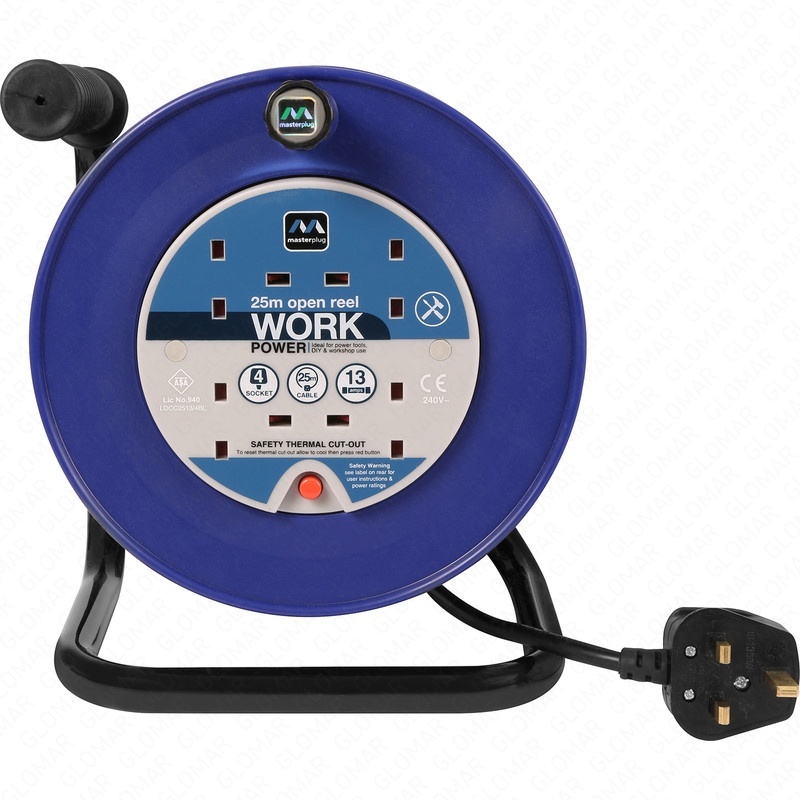
  • Cable Reels: Ideal for managing longer lengths. Choose between “open drum” (often used on sites) and “closed cassette” (more common for home/garden).
    • Thermal Cut-Out: ESSENTIAL feature for cable reels. This safety device automatically cuts power if the cable overheats, preventing fires. Always look for this.
    • “Unwound” Rating: Note that cable reels often have a lower amperage rating when the cable is still wound up. Always uncoil the cable fully when using high-power tools to avoid overheating.
  • Multi-Socket Leads: Useful for powering several tools or chargers. Ensure the total power draw of all connected devices does not exceed the lead’s maximum rating.

5. Ingress Protection (IP) Rating

If you’re working outdoors or in damp/dusty conditions, an IP-rated extension lead is crucial. The IP rating indicates its resistance to solids (first digit) and liquids (second digit).

  • IP44: Protected against solid objects over 1mm and splashing water from any direction. Good for general outdoor use.
  • IP65: Dust tight and protected against low-pressure water jets from any direction. Suitable for demanding outdoor or dusty workshop environments.

Actionable Advice: For garden work with a Stihl strimmer or Kärcher pressure washer, aim for at least IP44. For site work in unpredictable British weather, IP65 or higher is recommended.

6. Residual Current Device (RCD) Protection

An RCD is a life-saving device that immediately cuts off electricity if it detects an imbalance in the current, indicating an earth fault (e.g., someone touching a live wire). While many modern power tools have double insulation, an RCD offers an additional layer of protection.

Actionable Advice: If your mains socket doesn’t have built-in RCD protection, consider buying an extension lead with an integrated RCD or an RCD adaptor that plugs directly into the socket. This is especially important when using power tools outdoors.

Practical Scenarios: Matching Your Lead to Your Task

DIY & Garden Work (240V)

For home improvement projects with your Makita drill, Bosch sander, or powering garden tools like a Flymo lawnmower, a good quality 240V extension lead is needed. Look for:

  • 1.5mm² or 2.5mm² cable for lengths up to 25m.
  • IP44 rating if used outdoors.
  • Thermal cut-out if it’s a cable reel.
  • Integrated RCD for maximum safety, especially outdoors.

A 25m Arctic-grade 2.5mm² cable reel with an RCD from brands like Masterplug or Draper can cost £40-£80.

Workshop/Garage Use (240V)

If you’re running multiple tools – perhaps a Festool dust extractor, a DeWalt planer, and a bench grinder – you’ll need a robust solution:

  • A heavy-duty 240V cable reel, perhaps 25-50m, with at least 2.5mm² cable.
  • Multiple sockets, ensuring total current draw doesn’t exceed the reel’s rating.
  • Thermal cut-out is non-negotiable.

Consider a heavy-duty open drum reel from a brand like Defender, often £60-£120.

Professional Site Work (110V)

For demanding construction environments, safety and durability are paramount:

  • 110V “hi-vis” yellow leads with 16A or 32A commando plugs.
  • Cable thickness of 2.5mm² or 4.0mm² for longer runs and high-power tools.
  • IP65 rating for dust and water protection.
  • Robust, impact-resistant construction.
  • Often comes in 14m, 25m, or 50m lengths.

A 25m 110V 2.5mm² site extension lead can range from £40-£90 from reputable brands.

Maintaining Your Extension Leads for Longevity and Safety

  • Inspect Regularly: Before each use, check for cuts, cracks, exposed wires, or signs of overheating (discolouration, melting).
  • Store Properly: Coil leads neatly (avoiding tight bends) and store them in a dry, protected place away from direct sunlight, extreme temperatures, and chemicals. For cable reels, ensure the cable is fully retracted.
  • Avoid Overloading: Never exceed the maximum amperage rating of the lead.
  • Keep Clear: Don’t run leads through doorways where they can be pinched, under carpets where heat can build up, or across busy walkways where they can be tripped over.
  • Never Repair Damaged Leads: If a lead is damaged, replace it immediately. "Temporary" tape repairs are dangerous.

Where to Find the Best Deals on Extension Leads in the UK

Once you’ve identified the right type of extension lead for your power tools, it’s time to find the best price. Major UK retailers like Screwfix, Toolstation, Amazon UK, Wickes, and B&Q all stock a wide range of extension leads, from basic domestic options to heavy-duty industrial models.

Top Tip: Don’t just settle for the first price you see! Prices can vary significantly between suppliers. This is where DSIDE.co.uk comes in handy. You can easily compare prices from all the leading UK retailers for the exact extension lead you need, ensuring you get the best value without compromising on safety or quality.

Conclusion: Power Up Smartly, Stay Safe

Choosing the right extension lead for your power tools isn’t just about convenience; it’s about safety, efficiency, and prolonging the life of your valuable equipment. By understanding voltage requirements, cable thickness, safety features, and IP ratings, you can make an informed decision.

Prioritise safety above all else, always match the lead to the task, and remember to compare prices on DSIDE.co.uk to power your projects smartly and affordably. Happy drilling, cutting, and grinding!

Comments (0)

Please log in to leave a comment.

No comments yet. Be the first to share your thoughts!

200,000+ Products
220+ Trusted Sellers
183,000+ Price Points
72hr Price Updates

Featured Brands

All Brands